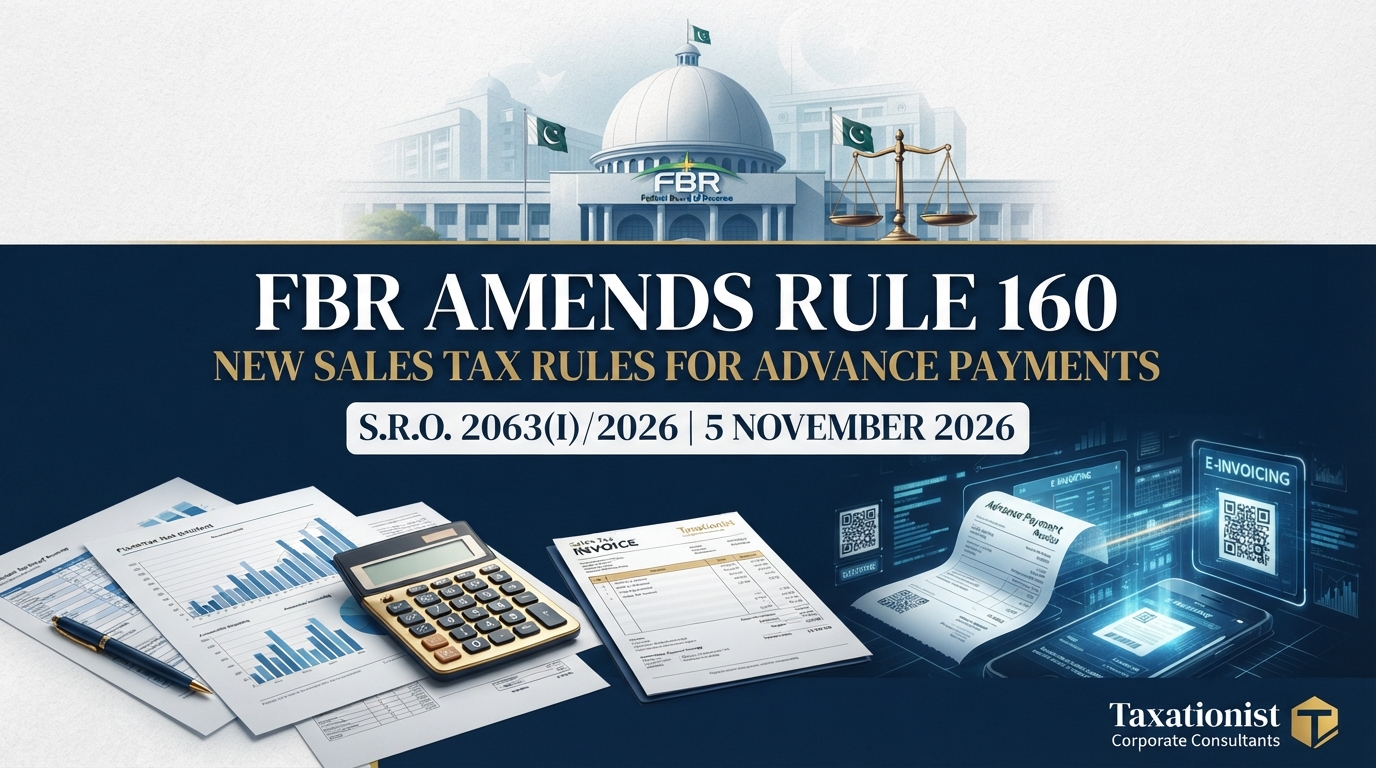
FBR’s S.R.O. 2063(I)/2026 amends Rule 160 of the Sales Tax Rules, 2006, introducing revised requirements for advance payment invoicing, tax rate application, electronic invoice linkage and sales tax adjustments.
The Federal Board of Revenue (FBR) has introduced an important change in the treatment of advance payments under the federal sales tax regime through S.R.O. 2063(I)/2026 dated 5 November 2026, amending Rule 160 of the Sales Tax Rules, 2006. The amendment addresses a long-standing practical issue in commercial transactions: how sales tax should be accounted for when a registered person receives money before actually delivering goods or completing a supply. Under the revised framework, an advance payment is no longer merely a financial transaction to be reconciled when the final invoice is issued. It now requires a separate advance receipt invoice, declaration of output tax in the relevant tax period, and electronic linkage with subsequent advance receipts and the final sales tax invoice. This is a significant compliance development because it brings the receipt of advances, tax accounting, invoice issuance and electronic transaction traceability into one connected process.
The amendment has been made under section 50 of the Sales Tax Act, 1990, read with sections 9 and 23 of the Act. It substitutes the existing Rule 160 with a new provision titled "Accounting for advance payments against supplies."
An important distinction must be made before examining the changes. S.R.O. 2063(I)/2026 does not introduce the concept of sales tax on advance payments for the first time. The earlier version of Rule 160 already required a registered person receiving an advance payment to issue an advance receipt invoice and declare the corresponding output tax in the return for the tax period in which the advance was received.
The legal basis is found in section 2(44) of the Sales Tax Act, 1990, which defines the expression time of supply. In relation to ordinary supplies of goods, the time of supply is the time when goods are delivered or made available to the recipient, or the time when payment is received by the supplier in respect of that supply, whichever is earlier.
Consequently, where a supplier receives an advance against an identifiable taxable supply of goods, the receipt of payment can establish the time of supply even though the goods have not yet been delivered.
The earlier Rule 160, as contained in the Sales Tax Rules, 2006 updated up to 31 July 2026, already provided for:
The earlier framework was therefore not silent on advance payments. The real issue was that it did not contain the same detailed mechanism for handling multiple advances, electronic cross-referencing, rate changes and adjustments that the new amendment now expressly provides.
The notification substitutes Rule 160 in its entirety. The revised rule contains six sub-rules and establishes a more detailed procedure for accounting for advance payments.
Under revised Rule 160(1), where a registered person or class of persons to whom section 23 applies receives an advance payment, whether in full, in part or through one or more instalments, an advance receipt invoice must be issued at the time of receipt.
The invoice must contain the particulars specified under section 23 of the Sales Tax Act, 1990, to the extent applicable.
More importantly, the supplier must account for and declare the output tax in the return for the tax period in which the advance payment is received.
This reinforces the statutory position that a supplier cannot defer the declaration of output tax merely because the goods have not physically been delivered.
One of the more significant additions is found in Rule 160(2).
Where a supplier receives multiple advance payments against the same supply, a separate advance receipt invoice must be issued for each payment. Every subsequent invoice must also be electronically linked with the preceding advance receipt invoice or invoices.
This requirement is intended to establish complete traceability of all advances received against a particular supply.
For example, if a manufacturer receives three instalments from a buyer under a single purchase contract, the manufacturer cannot simply issue one consolidated advance invoice at the time of final delivery. Each receipt must be separately invoiced and electronically connected with the earlier receipts.
This is a welcome development from an audit and reconciliation perspective. It also places an additional responsibility on businesses to maintain properly integrated invoicing and accounting systems.
Revised Rule 160(3) provides that when the actual supply takes place, the supplier must issue a final sales tax invoice with reference to the relevant advance receipt invoices.
The value of the supply and sales tax already accounted for against the advances must not be declared again. Sales tax on the remaining value, if any, is to be calculated only on the portion not previously accounted for.
This provision is particularly important because double accounting of output tax has been a practical concern where advance receipts and final invoices are maintained separately.
The amendment makes the reconciliation requirement express and requires the final invoice to reflect the advances already taxed.
Perhaps the most commercially important provision is revised Rule 160(4), which expressly addresses changes in the applicable sales tax rate between the receipt of an advance and the actual supply.
It provides that:
This provision is particularly relevant for long-term supply contracts, manufacturing orders, construction-related goods contracts and transactions involving instalment payments.
This approach provides a clear statutory mechanism for transactions extending across different tax-rate periods. It also reduces disputes over whether the rate applicable at the time of the advance or at the time of delivery should apply to the entire contract.
However, businesses must maintain a payment-wise tax calculation rather than applying one rate to the entire contract. Where several advances are received on different dates, each advance must be separately accounted for at its applicable rate.
Rule 160(5) deals with situations where, after the issuance of an advance receipt invoice:
The amendment directs that the corresponding adjustment shall be made in accordance with section 9 of the Sales Tax Act, 1990 and Rules 19 to 22 of the Sales Tax Rules, 2006.
Section 9 provides the statutory mechanism for issuing debit or credit notes where a supply is cancelled, goods are returned, the nature of supply changes or the value of supply is modified, resulting in a corresponding change in the tax invoice or return.
This is an important clarification because an advance payment may be received and taxed in one period, while the cancellation or refund may occur in a subsequent period.
The tax adjustment must therefore be supported by the appropriate documentation rather than simply reversing the original accounting entry without reference to the statutory procedure.
The final requirement is contained in Rule 160(6).
Every advance receipt invoice, debit note or credit note issued in relation to it, and the final sales tax invoice must be electronically linked and maintained in the manner prescribed under the Rules or as specified by the Board under section 23.
This creates an interconnected documentary trail from the first receipt of payment to the final settlement of the transaction.
The significance of this requirement extends beyond invoice issuance. It gives the FBR a better opportunity to compare declared advances, subsequent adjustments and final supplies.
The revised provisions should therefore be read alongside section 22, which requires registered persons to maintain records of their purchases and supplies, section 23 concerning tax invoices, and section 24 concerning retention of records and documents.
There are genuine advantages in the revised framework, particularly from the perspective of tax administration and transaction transparency.
Advantages
These are meaningful improvements. In a tax system where invoice manipulation, unreported receipts and differences between declared sales and banking transactions remain concerns, better transaction-level documentation is a reasonable compliance objective.
However, the amendment also raises practical concerns.
Disadvantages and areas of concern
First, issuing a separate invoice for every instalment can create an additional administrative burden, particularly for manufacturers, distributors and businesses receiving hundreds of advance payments every month.
Second, electronic linkage depends on the availability of a functional and reliable invoicing system. Businesses with outdated accounting software may face implementation costs, technical difficulties and reconciliation errors.
Third, the treatment of refunds and cancelled contracts requires careful attention. A supplier may have already deposited the output tax on an advance, but a subsequent cancellation may create a cash-flow problem if the corresponding adjustment is delayed or disputed.
Fourth, the rate mechanism, although useful, requires proper contractual and accounting controls. Where payments are received in several tax periods, businesses must maintain a clear record of the applicable rate, taxable value and tax already declared against each instalment.
Finally, the FBR should ensure that the electronic system does not become an additional source of unnecessary notices and technical disputes. An invoice-linking error should be distinguishable from an actual suppression of taxable supplies.
The amendment should therefore be appreciated for improving accountability, but its success will depend on the practical implementation of the electronic system and the availability of a fair adjustment mechanism.
There are a few legal aspects that registered persons should not overlook while implementing the revised Rule 160.
First, the distinction between goods and services must be maintained. Section 2(44) of the Sales Tax Act, 1990 provides different time-of-supply rules for goods and services. For ordinary supplies of goods, receipt of payment may trigger the time of supply, whichever is earlier than delivery. However, clause (c) provides that, in relation to services, the time of supply is when the services are rendered or provided.
Accordingly, the revised Rule 160 should not be treated as automatically extending the advance-payment mechanism to every service transaction or to services governed by provincial sales tax legislation. Its application must be determined by reference to the scope of the federal Act, section 23 and the relevant statutory provisions.
Second, input tax adjustment must be examined separately. Rule 160 expressly treats the advance receipt invoice as a tax invoice for the purposes of sections 7 and 8. Section 7 provides the mechanism for determining the registered person's net sales tax liability by allowing admissible input tax against output tax, subject to the restrictions under the Act. Section 8, in turn, specifies circumstances in which input tax credit is not allowed.
Therefore, the buyer's entitlement to claim input tax against an advance receipt invoice should be examined with reference to the invoice particulars, registration status, taxable purpose and other applicable restrictions. The mere issuance of an advance receipt invoice does not remove the statutory conditions governing input tax adjustment.
Third, the FBR must provide a workable electronic procedure. Section 23 empowers the Board to regulate tax invoices and electronic invoicing. Rule 160(6) relies on the prescribed electronic mechanism for linking advance invoices, adjustment notes and final invoices. Clear technical instructions, standardised invoice references and a practical correction mechanism will be necessary to avoid disputes arising from system errors.
S.R.O. 2063(I)/2026 is a positive step towards improving the documentation and accounting of advance payments under Pakistan's federal sales tax system. Its real contribution is not the introduction of a new tax on advances, because the earlier Rule 160 already required advance invoicing and declaration of output tax upon receipt. Rather, the amendment addresses weaknesses in the earlier procedural framework by requiring separate invoices for multiple advances, electronic linkage of subsequent receipts, proper reconciliation at the time of final supply and express application of the relevant tax rate to each advance and the remaining value of the transaction. These changes can improve tax transparency, strengthen the audit trail and reduce the possibility of double accounting. Nevertheless, the FBR must recognise that better compliance cannot be achieved through additional documentation alone.
Businesses need a reliable electronic invoicing facility, clear instructions for cancelled contracts and refunds, and a straightforward mechanism for correcting genuine invoicing errors. Small and medium-sized businesses should not be exposed to unnecessary compliance difficulties merely because their accounting systems are not fully integrated. A sound sales tax system must ensure that tax is collected at the correct time, on the correct value and at the correct rate, without imposing an unreasonable administrative burden on genuine taxpayers. The amendment deserves appreciation for bringing greater clarity and accountability to advance-payment transactions, but its ultimate success will depend on whether the FBR implements it as a practical compliance measure rather than another layer of procedural complexity.
Download the SRO: https://download1.fbr.gov.pk/SROs/202611512115850979SRO2063dated5-11-2026.pdf
Copyright @ Taxationist. Designed By TechWare House