Sindh High Court rules a blank withholding statement defeats final tax regime eligibility under section 154A. Key facts, arguments, verdict and lessons for IT exporters.
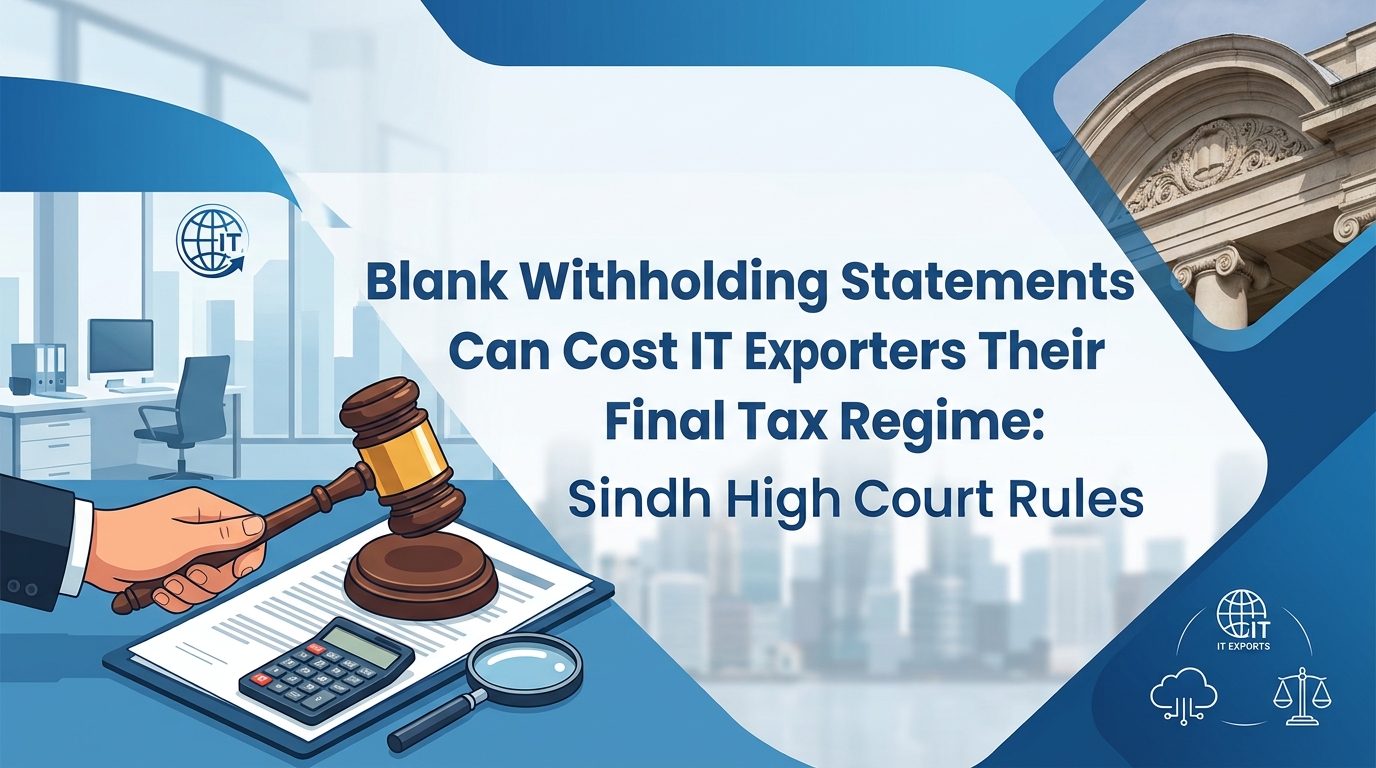
In A.C. Technologies v. Commissioner Inland Revenue (Income Tax Reference Application No. 419 of 2025, decided 12 October 2026), the Sindh High Court held that an exporter who files a blank quarterly withholding statement, despite having deducted tax, loses the final tax regime under section 154A of the Income Tax Ordinance, 2001.
A.C. Technologies, a PSEB-registered IT exporter, declared export receipts of Rs. 229,906,949 for tax year 2023 and paid tax at the reduced rate of 0.25%, or Rs. 574,765. During amendment proceedings, the department found that the statement for July to September 2022 contained no entries, although eight tax payments under sections 149 (salary) and 155 (rent) had been made that quarter. The officer treated the receipts as subject to the normal tax regime and raised a demand of Rs. 79,032,325. The Appellate Tribunal upheld the loss of final tax treatment but remanded the matter for computation of taxable income after admissible deductions.
A.C. Technologies argued that clause (b) requires only that statements be “filed”, that a statement was in fact filed, and that its content is irrelevant. It said any defect is addressed by a penalty under section 182, not by denial of the regime. It also called the requirement procedural, aimed only at reporting uniformity. The department supported the Tribunal’s order.
The Court rejected these arguments. It read section 154A(2)(b) together with section 165 and held that the condition is met only by filing the statement the Ordinance prescribes, one that sets out payments made and tax deducted. A nil statement is permitted only where nothing was deducted. Here deductions had been made, so the statement was “compliance in form only”. The annual statement did not help, as section 165 treats quarterly and annual statements as separate obligations and the annual statement covered only section 155 deductions. The Court also noted that A.C. Technologies could have filed a revised statement under section 165(2A) within sixty days, as it did for the next quarter, but did not.
On section 182, the Court held that penalties and loss of finality operate in different fields. A penalty answers breach of a withholding agent’s duty, while section 154A(3) states that sub-section (2) does not apply if a condition is unfulfilled. Otherwise an exporter could file blank statements, pay the penalty and keep the concession. The Court also rejected the plea of beneficial construction, which governs the extent of a benefit, not the conditions for claiming it. The reference was dismissed against the taxpayer.
Lessons for taxpayers
First, a filed statement is not necessarily a compliant one, and content matters as much as filing. Second, reconcile every quarterly statement against payment challans and the IRIS record before the due date. Third, use the revision window under section 165(2A) promptly, since the Court treated timely correction as curing the defect. Fourth, annual statements cannot substitute for quarterly ones. Finally, the Court distinguished clerical or arithmetical slips, which may be tolerated, from omission of the very deductions a statement exists to disclose.
Conclusion
The judgment confirms that the final tax regime is a conditional concession. Exporters who claim 0.25% treatment should treat withholding compliance as a prerequisite to the concession, not a back-office formality.
Copyright @ Taxationist. Designed By TechWare House